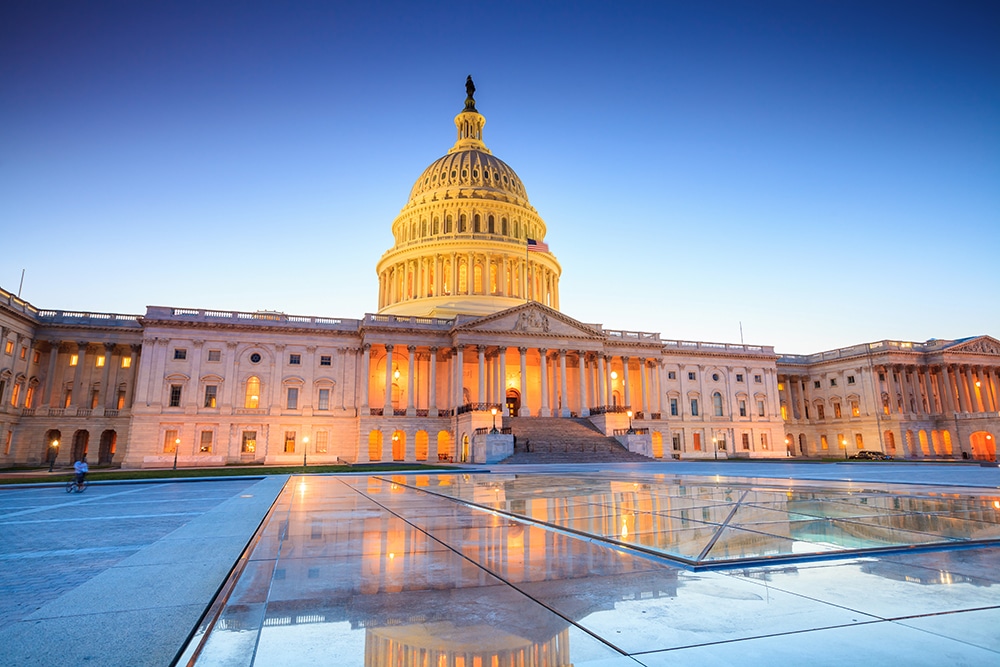
Last week, the U.S. Senate sent President Trump an appropriations package for Fiscal Year 2026 that includes funding for several federal agencies, including the Department of the Interior and the Commerce Department. While it’s a wonky and tedious process to engage in, appropriations bills include important policy directives that can have real, on-the-water impacts for the sportfishing industry, anglers and communities that rely on the $230 billion economic impact from recreational fishing.
This so-called “minibus” includes several provisions worth highlighting. Here are ten things ASA likes in this package and why they matter:
1. Greater flexibility for managing public recreation sites
The bill updates the Water Resources Development Act to allow local governments to use recreation fees collected at U.S. Army Corps of Engineers civil works projects (including reservoirs around the country) across any recreation site or facility within that project, not just the specific site where the fee was collected. This fixes a long-standing problem for day-use parks that do not charge user fees and therefore lack resources for basic upkeep. This solution provides local governments with more flexibility to keep all public recreation sites open, safe and clean, regardless of whether the specific site charges fees.
2. Continued protection from unwarranted lead tackle regulation
The bill maintains a long-standing prohibition on using federal funds to regulate the lead content of fishing tackle under the Toxic Substances Control Act or any other law. This language provides certainty for anglers and manufacturers and prevents government overreach that would increase costs and discourage participation without a scientific basis.
3. Investment in South Atlantic reef fish data and state management
The package provides $3.15 million for South Atlantic red snapper research and to implement state management, including $1.35 million to support state exempted fishing permits (EFPs). It also includes an additional $2.5 million for enhanced fisheries independent data collection of South Atlantic reef fish stocks.
Through these actions, Congress is providing strong support for states to begin managing South Atlantic red snapper in 2026. This is a meaningful step toward management approaches that better reflect local conditions and expand recreational fishing access.
4. A push for science-based decision-making in Biscayne Bay
House report language urges a reconsideration of the fishing moratorium in Biscayne National Park that was approved outside the traditional fishery management plan process and over the objections of the State of Florida. The language emphasizes collaboration with the Florida Fish and Wildlife Conservation Commission, consideration of less restrictive alternatives, and the use of rigorous scientific monitoring before implementing sweeping access restrictions.
5. Support for oyster aquaculture and habitat restoration
The joint explanatory statement reinforces House language directing NOAA Fisheries to enhance oyster aquaculture, improve oyster habitat, map oyster beds, monitor water quality, and expand partnerships across all levels of government. Up to $5 million is provided for this work.
Healthy oyster reefs deliver real benefits to fisheries by providing habitat, improving water quality, strengthening coastal resilience, and supporting a high-value commercial and recreational resource.
6. Investment in real-time whale monitoring technology
The Senate report provides up to $5 million for a near real-time whale monitoring and mitigation pilot program and encourages NOAA to work with other federal agencies, industry and academia on technology development. Real-time monitoring tools can help reduce vessel strikes, support right whale recovery, and allow continued, compatible access to shared ocean space for boaters and anglers.
7. Better data on Atlantic menhaden in the Chesapeake Bay
The Senate report directs at least $2.5 million toward collecting Atlantic menhaden abundance data in the Chesapeake Bay in partnership with states and the Atlantic States Marine Fisheries Commission. Menhaden are a cornerstone forage species for striped bass, bluefish and other marine life. Better data means better management decisions for the entire ecosystem and the recreational fisheries that depend on it.
8. Increased funding for Mitchell Act hatcheries
The minibus provides $4 million above fiscal year 2024 levels for the operation and maintenance of Mitchell Act hatcheries and directs NOAA to continue genetic stock identification work. These hatcheries play a critical role in salmon and steelhead recovery in the Columbia River Basin and support both conservation goals and recreational fishing opportunities.
9. Strong funding for Pacific salmon recovery and science
The bill includes $65 million for the Pacific Coastal Salmon Recovery Fund, $70.75 million for salmon fisheries science and management activities, and $75.75 million for protected resources science and management related to Pacific salmon. This level of investment reflects the importance of salmon to regional economies, recreational fishing and long-term conservation outcomes.
10. Continued support for the National Fish Habitat Partnership
The House Interior report includes $7.145 million for the National Fish Habitat Partnership (NFHP). These partnerships deliver on-the-ground habitat improvements that directly benefit fish populations, water quality and angler access across the country. From 2021-2025, NFHP supported 434 aquatic habitat restoration projects across 46 states through science-based, locally driven partnerships.
Appropriations bills frequently dominate the news cycle when deadlines loom and shutdowns are on the line. What receives less attention are the policy decisions embedded in these packages that shape how agencies operate and how access, conservation and science are carried out on the water. This minibus reflects meaningful progress for recreational fishing, and ASA will continue working to make sure these provisions are implemented in ways that support anglers, businesses and healthy fisheries.
Share This Article, Choose Your Platform:
Recent Posts

AUTHOR