Even though winter may still have most of the country in its icy grip, the days are officially getting longer, and the calendar finally flipped to 2026. As we enter this new year, several outstanding recreational fishing policy priorities remain on the to-do list for the Trump administration, Congress and federal agencies.
Unquestionably, 2025 was a year marked by uncertainty. From tariffs to the longest federal shutdown in our nation’s history, every week seemed to bring its own surprise. Sprinkled in between the headlines were a bunch of wins, though. The MAPWaters Act became law in December, fishing access was restored off the California coast in areas previously closed due to a faulty quillback rockfish stock assessment, and NOAA withdrew two potentially disastrous proposed rules – one that would have closed the Atlantic Ocean to all vessels above 35’ for over half the year, and another that would have closed the South Atlantic to bottom fishing for 3 months in Florida.
With 2026 upon us, all eyes are on the midterm elections this November. Before we even get into election season, though, Congress must pass a funding bill before the January 30 deadline. Fortunately, recreational fishing remains a strongly bipartisan issue, and we are optimistic that our industry’s priorities will make it across the finish line before the 119th Congress ends.
Tackling Shark Depredation
Following swift passage in the House and later the Senate Committee on Commerce, Science and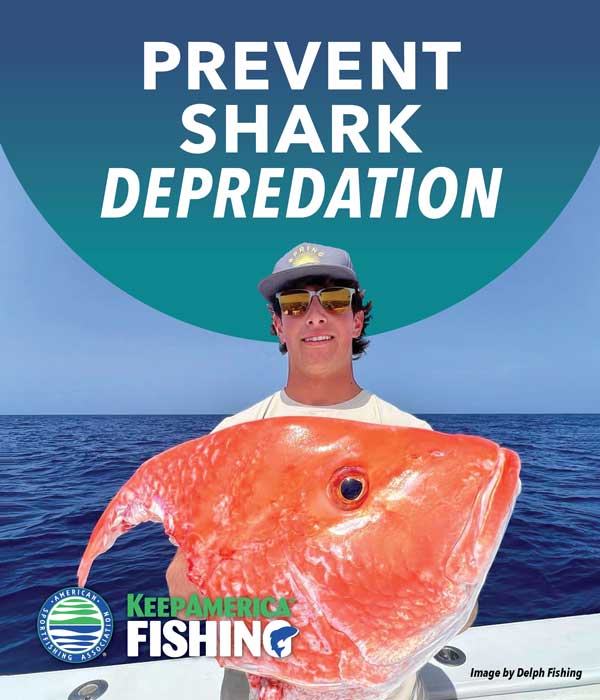 Transportation last August, the SHARKED Act is poised to hit the Senate floor early in 2026. This critical legislation creates a task force comprised of fisheries managers and shark experts responsible for improving coordination and communication across the fisheries management community on shark depredation.
Shark depredation, or when a shark consumes part of all of a fish before the angler can safely land it, has become a growing frustration for America’s anglers and fishing industry, particularly in the Southeast and Gulf. One of the main obstacles in lessening shark-human interactions on the water is the complex management authority of shark species, with the federal government, states and international treaties maintaining various levels of oversight.
Red Snapper in the South Atlantic
The South Atlantic states are closer than ever to securing management authority of their respective red snapper fisheries following decades of heavy-handed restrictions from NOAA Fisheries. Late last year, Florida, Georgia, and both Carolinas submitted applications for Exempted Fishing Permits (EFP’s) to collect better data on the health of the stock and recreational fishing effort in the region.
Red snapper management has been defined by nothing short of frustration in the Southeast U.S. In 2025, anglers were permitted to target red snapper for just two days, which was twice as many as the single-day season in 2024. These meager seasons are based on flawed data from NOAA’s Marine Recreational Information Program (MRIP), which even the agency has acknowledged overestimates fishing effort by as much as 40%. Even NOAA’s own scientists agree with anglers and the industry that there are more red snapper in the South Atlantic right now than any time in recent history. It’s past time we are rewarded with commensurate access to this fishery, and the proposed EFP’s are the start of this process.
Thanks to the leadership of the four Governors, Attorneys General, and Congressional champions, notably Reps. John Rutherford (R-FL), Darren Soto (D-FL), Buddy Carter (R-GA), Russell Fry (R-SC), and David Rouzer (R-NC), we’re optimistic the EFP’s will be met warmly by the Secretary of Commerce, the 2026 red snapper season will be measured in weeks rather than hours.
Dingell-Johnson Reauthorization
 Last but certainly not least, the Dingell-Johnson Act must be reauthorized before its expiration this Fall. Widely lauded as the most important fisheries conservation bill in our Nation’s history, Dingell-Johnson authorizes the collection of up to a 10% excise tax on sportfishing tackle and a portion of the motor boat fuel tax. This funding, which our industry proudly contributes, is distributed to states, tribes and territories for fisheries conservation through the Sport Fish Restoration Program.
Since its inception in 1950, this user-pay, public-benefit system has generated more than $12 billion for habitat restoration, research, public access and fish stocking, including more than $700 million in 2025.
In June of last year, Reps. Debbie Dingell (D-MI) and Rob Wittman (R-VA) introduced must-pass legislation to reauthorize this critical program through 2031.
Additionally, the Sporting Goods Excise Tax Modernization Act, sponsored by Sens. Tommy Tuberville (R-AL) and Mike Crapo (R-ID), as well as Reps. Jimmy Panetta (D-CA), Blake Moore (R-UT), Mike Thompson (D-CA) Greg Murphy, M.D. (R-NC), Troy Carter (D-LA), and August Pfluger (R-TX), would close a loophole in the Dingell-Johnson Act that allows overseas manufacturers who sell direct-to-consumer to bypass excise tax collection. This legislation would contribute tens of millions of dollars back to conservation and restore competitiveness for American manufacturers.
More to Come
The list doesn’t stop here, of course. We are working diligently to secure reauthorization of the Farm Bill, Water Resources Development Act, and the Great American Outdoors Act, all of which must be passed by the end of this Congress. We’ll continue our efforts to curb the spread of aquatic invasive species, address pinniped predation on salmon and steelhead, improve access to striped bass, and stop unnecessary bans on traditional tackle and live bait, as well. We’ll also continue to monitor and help our members navigate the ever-changing tariff environment, especially with the Supreme Court expected to rule on the legality of some of the President’s tariff declarations early in the year.
Our collective voice is stronger than ever, and we’re excited to get back to work on behalf of the sportfishing industry and America’s 58 million anglers.
P.S. – want to help protect sportfishing’s future? Join us April 12-15 for our inaugural Keep America Fishing Fly In in Washington, D.C., where you’ll have the chance to connect with legislators, engage with top Administration officials, and gain insight into the sportfishing policies shaping our future. Click the link above to learn more and register. Early bird pricing ends Jan. 30.
Share This Article, Choose Your Platform:
Recent Posts

AUTHOR