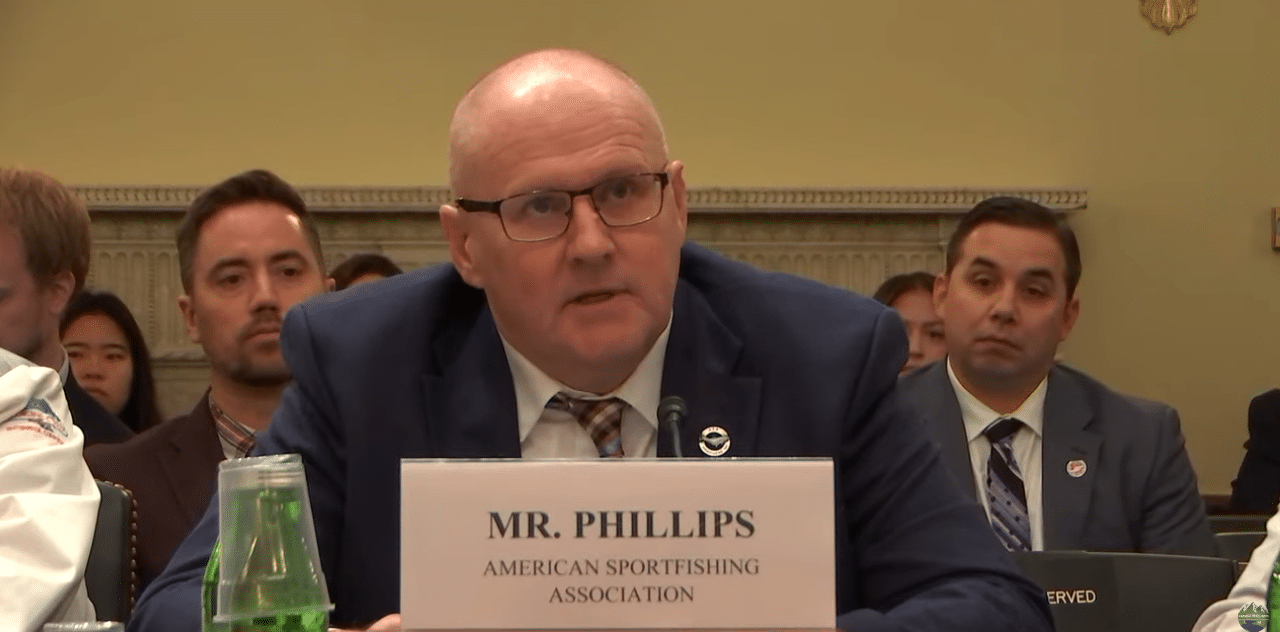
Alexandria, VA – December 3, 2025 – Earlier today, ASA’s Pacific Fisheries Policy Director, Larry Phillips, testified before the House Natural Resources Subcommittee on Water, Wildlife and Fisheries. Mr. Phillips emphasized the recreational fishing industry’s concerns with the detrimental impacts sea lions are having on salmon and steelhead populations in the Pacific Northwest.
“For decades, federal, state, and tribal partners – as well as anglers – have invested heavily in salmon recovery through habitat restoration, hatchery modernization, harvest reform, and hydropower mitigation,” said Phillips. “One major factor continues to erode those gains: pinniped predation on salmon and steelhead.”
Sea lions target dams where they can easily feed on returning salmon, causing a decline in spawning success and survivability.
In the Columbia River, sea lions that were nearly absent in the 1990s now number in the tens of thousands and can consume a significant portion – estimated as high as ~40 percent – of the spring Chinook run in a single season. In Puget sound, harbor seals consume up to 14 percent of juvenile Chinook annually and as much as one-third of steelhead smolts.
While sea lion predation of salmonids in the region is not new, the migration of these large predators to upriver sites such as Bonneville Dam is, and studies have shown that the use of dams for predation is a learned behavior among sea lion populations.
Although some management tools exist, such as relocation and lethal removal of individually identifiable “nuisance” pinnipeds, the Marine Mammal Protection Act still prevents meaningful action in many areas where predation is most acute. To support the recovery of Pacific Northwest salmon and steelhead, ASA recommends that Congress:
- Create a streamlined pathway for managing predatory pinnipeds in Puget Sound and along the Washington and Oregon coasts by expanding the location-based approach.
- Extend management authority to predation hot spots including Puget Sound and the coasts of Washington or Oregon.
- Provide dedicated federal funding to support monitoring, removals, and ongoing scientific analysis.
- Extend MMPA management authority to Washington’s treaty tribes and work collaboratively with Oregon’s tribal governments.
- Make meaningful investments in habitat, hatcheries, hydropower mitigation, and harvest reforms.
“Science shows these populations have rebounded dramatically in the modern era and many stocks are at or above their optimum sustainable population levels,” added Phillips.
ASA is grateful to Chair Hageman (R-WY), Ranking Member Hoyle (D-OR) and members of the Subcommittee for their focus on this issue and we look forward to working with Congress, federal agencies, state and tribal partners, and the sportfishing industry to enact solutions to this ongoing threat.
Click below to watch a recording of today’s hearing.
Share This Article, Choose Your Platform:
Recent Posts

AUTHOR