
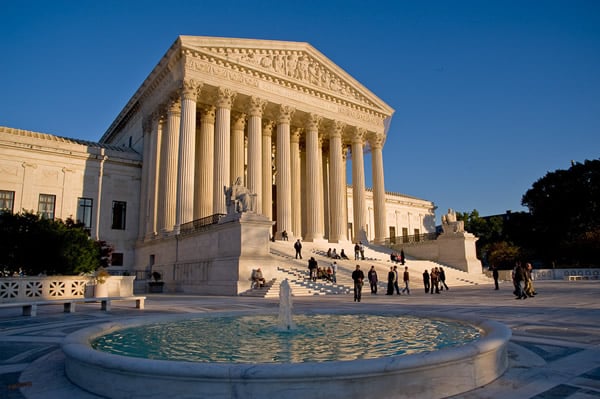
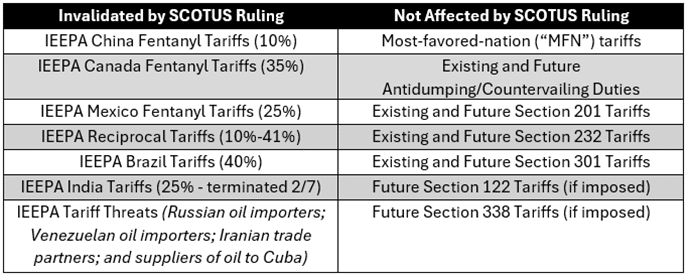
Today, the Supreme Court issued a 6-3 decision striking down President Trump’s use of the International Emergency Economic Powers Act (IEEPA) to impose tariffs. The decision invalidates the reciprocal/”Liberation Day” tariffs and the Canada, Mexico, and China “trafficking” tariffs imposed under IEEPA. Other tariffs imposed under different statutes, like Section 232 steel and aluminum tariffs, are not affected.
In the wake of the decision, the President pledged to promptly impose a new 10% global tariff under Section 122 that will become effective “three days from now.” The President also stated that the U.S. will soon initiate Section 301 and other investigations that could lead to the imposition of additional tariffs.
At this moment, Section 122 tariffs have not yet been imposed. Maintaining tariffs under Section 122 after 150 days requires Congressional approval.
The table below, prepared by ASA’s trade firm Sorini, Samet & Associates, lists which tariffs have been invalidated by today’s ruling, and those that are not affected:
What We Know:
- All trade actions taken under IEEPA have been invalidated.
- Trade actions under Section 122 have not yet been imposed as of this writing.
- Trade actions under Section 201, 232, 301, and any other trade remedy statutes remain unchanged.
What We Do Not Know:
- Whether, when, and how U.S. importers will be eligible to receive refunds for IEEPA duties paid.
- Whether the promised 10% tariffs under Section 122 will be imposed globally, or only countries with trade deficits.
- The precise day and time IEEPA duties will stop being imposed.
- The exact impact of how today’s decision will affect negotiated and signed “Agreements on Reciprocal Trade.
For additional information on the alternative trade authorities at the President’s disposal, please click here.
Share This Article, Choose Your Platform:
Recent Posts

AUTHOR